
How Hypnosis Works
What is Hypnosis?
Hypnosis is a naturally occurring state of focused attention, heightened suggestibility, and deep relaxation that you've likely experienced many times without realising it. Ever been so absorbed in a book or film that you lost track of time? That's a form of hypnosis.

It's often referred to a trance-like state, but it's not sleep or unconsciousness. During hypnosis, you remain fully aware of your surroundings and can hear and respond to suggestions. You might feel deeply relaxed and detached from distractions, but the key element is focused attention which allows your unconscious mind to become more accessible.
In a therapeutic context clinical hypnosis, more commonly called hypnotherapy, uses guided relaxation and concentration techniques to help you achieve specific goals. As your hypnotherapist, I help you access your unconscious mind to uncover and address issues that may be causing emotional distress or preventing personal growth.
How Your mind works
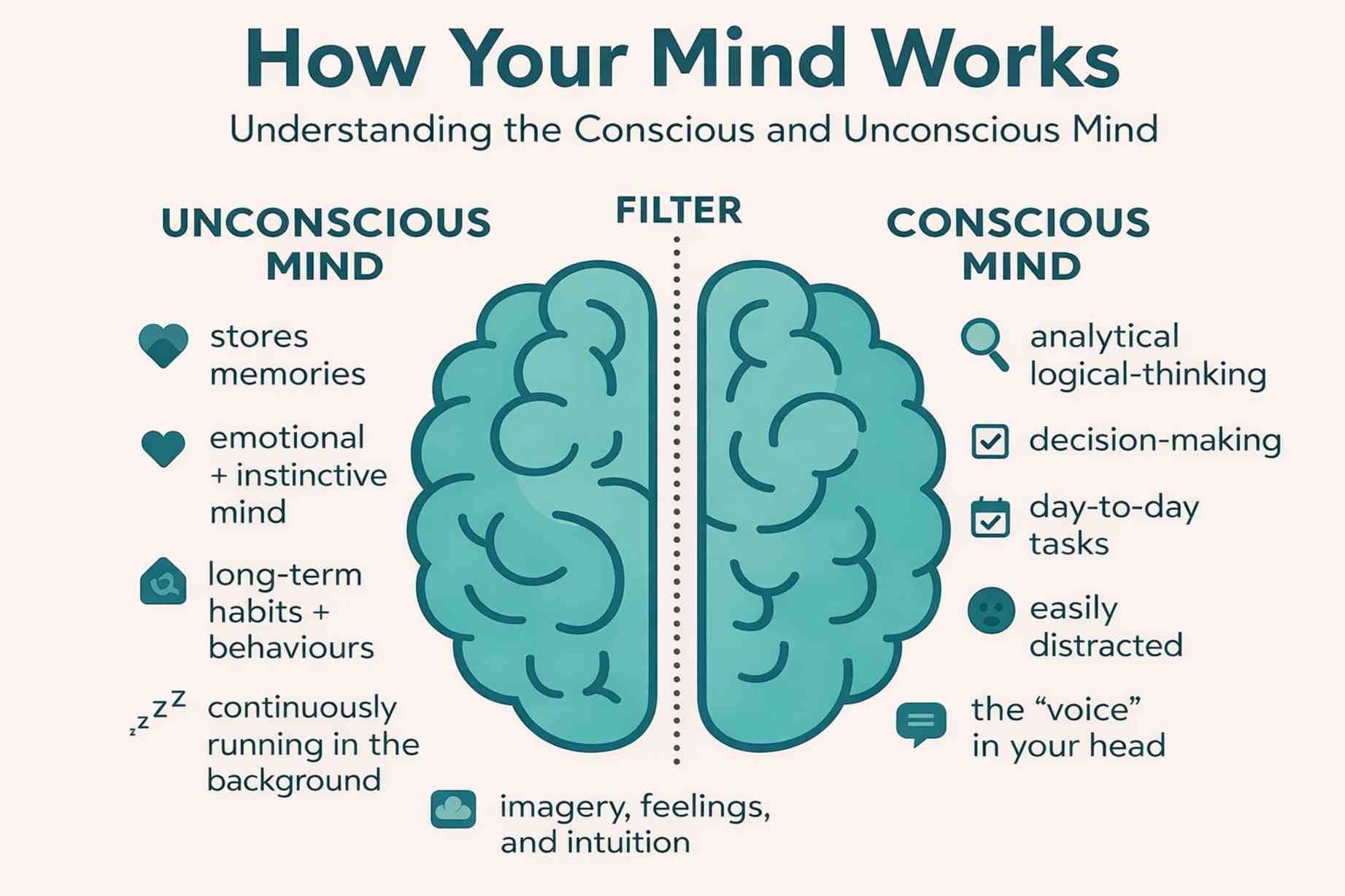
To understand how hypnosis works, it's essential to know about your mind's structure. The human mind consists of the conscious mind and the unconscious (or subconscious) mind.
The Unconscious Mind
This stores your emotions, memories, and learned behaviours. It operates automatically and isn't directly accessible to your conscious mind. The power of hypnosis lies in its ability to access and influence the unconscious mind.
Unlike the conscious mind, which is analytical and judgmental, the unconscious mind is more impressionable and less resistant to change. This makes it an ideal place to address and change deep-seated beliefs responsible for persistent issues. Some of the key functions and characteristics of the unconscious mind are:
Processes approximately 11 million bits of information per second
Controls habits, automatic responses, and conditioned behaviours
Houses emotions, beliefs, and deep-seated values
Primary role is to preserve the body, 'protect' and ensure survival
Does not process negatives (hears "don't think of a pink elephant" as "pink elephant")
Thinks in symbols, metaphors, and images rather than words
Operates in the present tense so cannot tell the difference between vividly imagined experience and reality
Takes everything personally and literally
The Conscious Mind
This is the part of your mind that handles logical thinking, decision-making, and day-to-day tasks. It's analytical and can be easily distracted by whatever's going on in the world around you. It's your "awake" mind — the voice in your head right now. Some of the key functions and characteristics of the unconscious mind are:
Processes approximately 40-50 bits of information per second
Logical reasoning, analysis, and critical thinking
Makes deliberate decisions and choices
Processes language, words, and linear thought
Works sequentially and linearly (one thought after another)
Operates in past, present, and future tenses
Can understand and process negatives
Functions as the "gatekeeper" to the unconscious mind

Ready To Change?
The power of hypnosis lies in its ability to access and influence the unconscious mind. Unlike the conscious mind, which is analytical and judgmental, the unconscious mind is more impressionable and less resistant to change. This makes it an ideal place to address and change deep-seated beliefs responsible for issues.
For example, someone struggling with weight loss might have deep-seated beliefs or past experiences that contribute to unhealthy eating habits. Hypnosis can help bring these issues to the surface, allowing the individual to reframe those beliefs and adopt healthier behaviours.


© 2026 Inner Insight Hypnosis - All Rights Reserved. Powered By HypnoBiz-in-a-Box™